


WHAT IS FIRST AID?
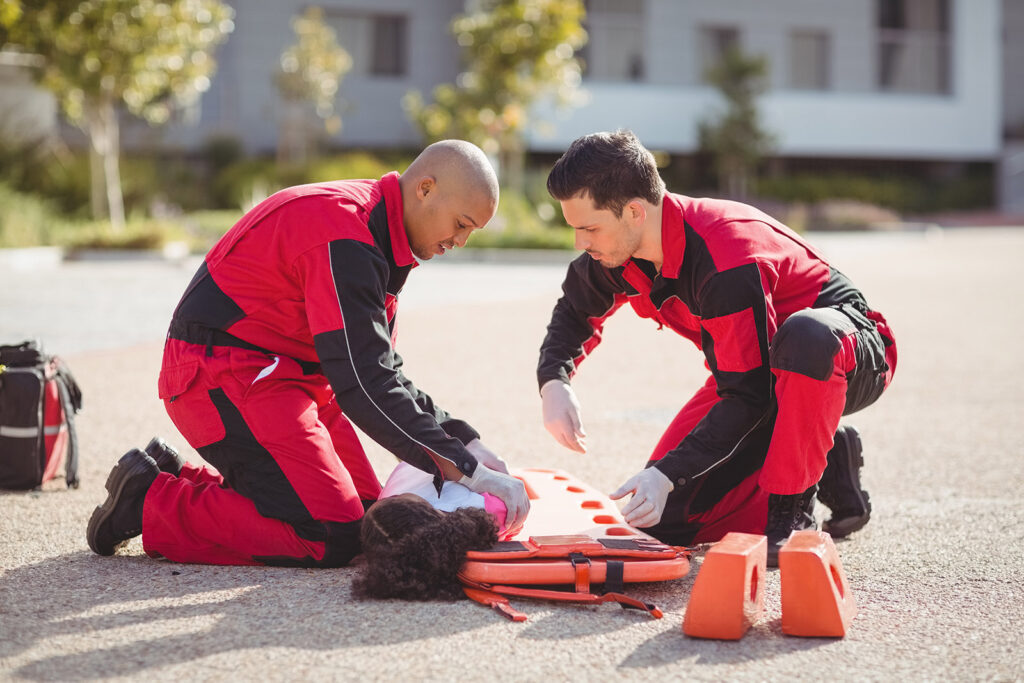
In any accident or in a life-threatening situation, until the medical assistance of paramedics is provided, in order to save the life of the person or to prevent the deterioration of his/her condition, the non-medicated applications made with the existing tools and equipment without seeking medical equipment at the scene are called first aid.
The aim of first aid is to prevent the deterioration of the condition of the patient or injured person and to ensure the application of the first aid techniques required to facilitate the healing process.
First aid
- It starts at the scene of the accident,
- It continues throughout the transportation of the sick and injured,
- It ends with the start of medical treatment at the health center reached.
- First aid intervention to the sick and injured until the arrival of the medical team is carried out by persons who have received first aid training and certification.
It includes the life-saving chain and all stages of first aid.
Notifying health institutions
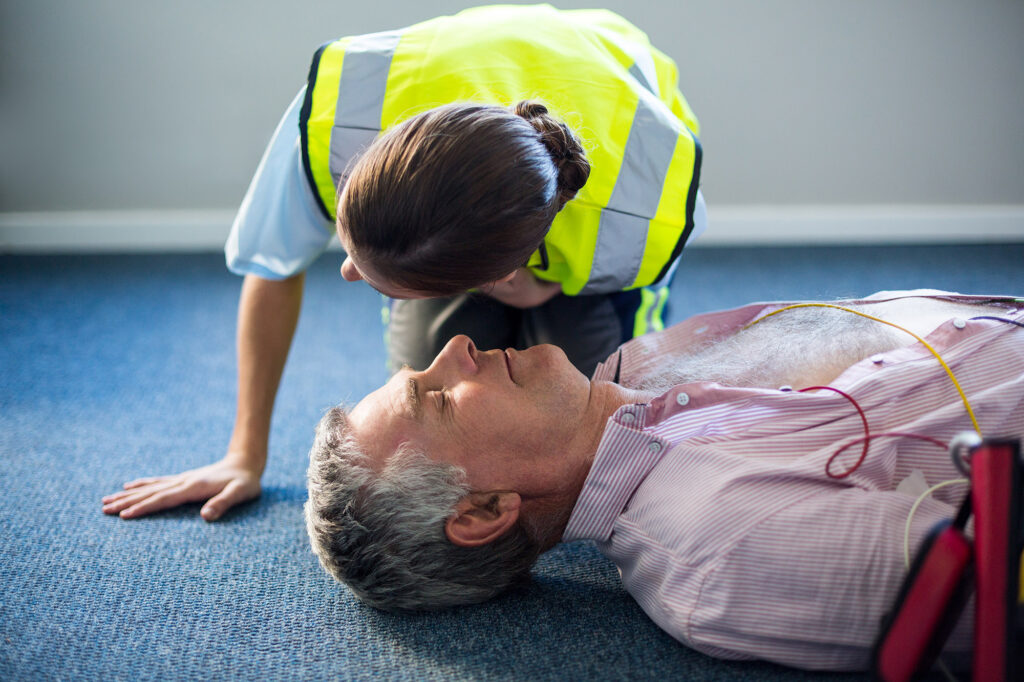
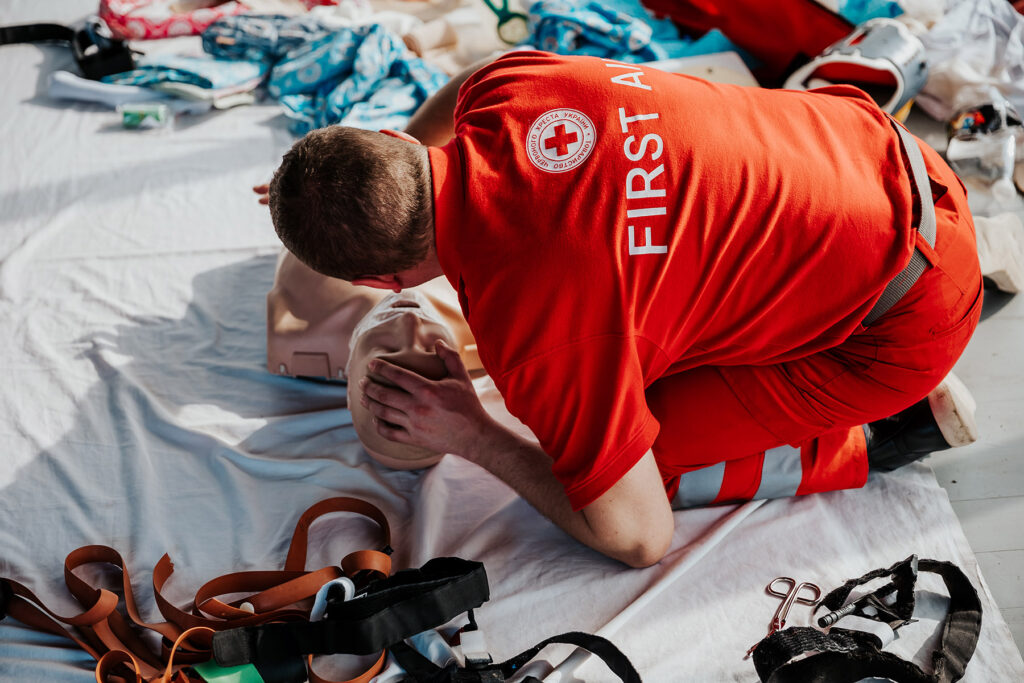
Basic life support at the scene
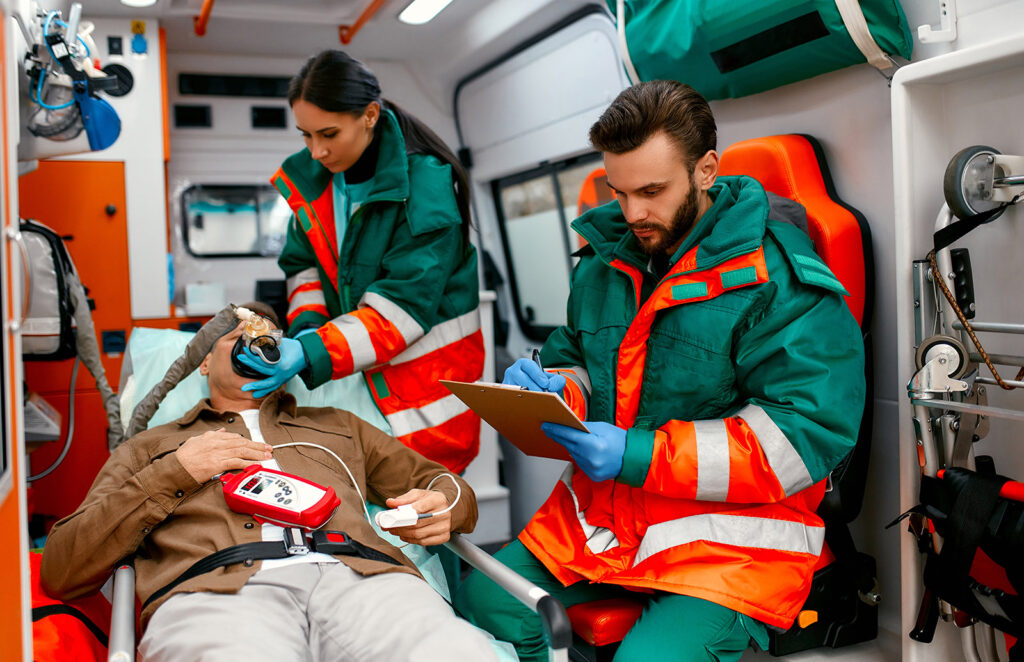
Ambulance team intervention
Hospital emergency room intervention
WHERE SHOULD FIRST AID KITS BE LOCATED?
First aid kits should be available quickly and easily accessible in emergency situations.
First aid kit bags and/or cabinets should be stored in places away from direct sunlight, and the bodies and lids of first aid kit bags and/or cabinets should not be transparent or see-through.
Sunlight has a negative effect on the packaging of first aid products in bags and cabinets, causing them to lose their effectiveness before their expiry date or sterile products to deteriorate.
First aid kits should be located in easily visible places and should be equipped with up-to-date materials that have not expired.
In addition, the contents should be checked regularly, expired materials should be replaced and missing ones should be completed.
For this purpose, it is recommended to place a control band on the bag and cabinet.
The points to be considered when positioning first aid kits can be summarized as follows;
AT HOME
It should be out of the reach of children but within easy reach of people familiar with emergency situations.
In frequently used areas such as kitchens or bathrooms, it can be located in high cabinets or mounted on walls.
WORKSPACES
It should be located in workplaces, factories, offices or infirmary rooms, especially at a point accessible to people familiar with emergencies.
IN VEHICLES
In cars, it can be stored in the trunk or in an easily accessible compartment.
In buses and trucks, it should be kept in an easily accessible place inside the vehicle, especially around the driver’s seat.
EDUCATION INSTITUTIONS
It should be located in the infirmary room of the educational institution or at points accessible to people who are knowledgeable about emergencies.
SPORTS HALLS AND STADIUMS
It can be found in the authorized doctor’s or nurse’s paramedic bag, or at points accessible to people familiar with emergencies.
IN PUBLIC SPACES
It should be kept in the infirmary rooms of places with large areas such as beaches, shopping malls, bus stations, train stations, or at one or more points accessible to the person who is knowledgeable about emergencies in the organization.
WHAT ARE FIRST AID SUPPLIES?
PLASTER
It is used for a stronger fixation of the gas compress, pad and bandage on the injured part of the limb.
It can be made of cloth, paper or nonwoven fabrics.
They are usually 2.5 cm x 500 cm or 5 cm x 500 cm in size.
WOUND BAND
It is used to protect small scratches and wounds against external factors and to ensure that the wound area does not open.
Band-aids are made of cloth, pu or waterproof films.
They come in a wide range of sizes.
The most common models in general use are 19 mm x 72 mm, 25 mm x 72 mm, 38 mm x 38 mm and 20 mm x 120 mm.
ADHESIVE WOUND PAD
It is used to protect large scratches and wounds against external factors, to ensure that the wound area does not open and to prevent infection.
They are packaged sterile.
They are produced from nonwoven fabric or waterproof film.
Generally used in 5 cm x 7.5 cm, 9 cm x 5 cm, 9 cm x 10 cm and 9 cm x 15 cm sizes.
ADHESIVE EYE PAD
It is used to protect the eye against external factors and to prevent the eye from moving if an object has escaped.
It is packaged sterile.
They are generally produced from nonwoven flexible fabric.
The most commonly used sizes are 5.8 cm x 8.3 cm, 9.5 cm x 6.5 cm.
BANDAGE CLOTH
- To detect the dressing material
- Stopping bleeding by applying pressure to the bleeding area
- It is used to slow blood flow when it is necessary to protect the dressing materials and fix them in place.
The most commonly used sizes are 5 cm x 150 cm, 10 x 150 cm, 10 cm x 350 cm and 15 cm x 150 cm.
Bandages are also produced as more functional (flexible bandages) under the name “elastic bandages”.
These bandages are especially included in the European Union lists.
ELASTIC BANDAGE
- Reducing or completely preventing the movement of that area in fractures, dislocations and sprains
- Reduce or prevent swelling
- Splints are used to slow blood flow when it is necessary to fix the splints.
The most commonly used dimensions are 6 cm x 100 cm, 6 cm x 200 cm, 10 cm x 150 cm and 15 cm x 150 cm.
TRIANGLE BANDAGE
- On the chest as an open dressing, for suspending a broken or sprained arm
- Rib and collarbone fractures as a wide bandage
- Narrow and folded roll dressings instead of roll dressings on the eye, ear, foot, wrist
- As a bandage, to stop bleeding by applying a tight bandage to areas with excessive bleeding
- Applying pressure after placing sterile gauze or band-aid on the wound
- It is used to fix splints.
It is a joker product that should be at hand at every point for the first assistant.
While in previous years it was produced from fabric, today it is produced from non-woven fabrics.
According to the norms of the European Union, the basic size is at least 96 cm x 96 cm x 136 cm.
The product must be produced in the shape of a right triangle.
EMERGENCY BLANKET
It is produced in 2 types as silver-colored and gold-silver colored.
Silver is used to reflect sunlight in hot weather and gold is used to retain sunlight in cold weather.
Although the silver color is used in all environments, the gold color is mainly used in snowy areas for easy visibility.
In Turkey, it is also referred to as “burn cover”, but this is not correct.
Areas where the emergency blanket is used:
- As a sleeping cover
- As an emergency column (in the process of folding and binding)
- As a medical tourniquet
- It is used to protect the person from exposure to sun heat or external factors such as cold and rain.
It can be produced in more than one size.
The basically accepted size is 160 cm x 210 cm for a two-color product.
However, the most commonly used size for a one-color product is 150 cm x 200 cm.
GAS COMPRESS
As open wound care and treatment, it is used to remove tissue fluids from the wound and to protect the tissue.
It reduces the risk of infection in the wound because it is surgically folded so that the thread does not come out of the edges.
The word gas actually refers to cotton tulle fabric.
For this reason, this product, which has been produced from porous fabrics woven with cotton yarn for many years, is now also produced from nonwoven fabrics with today’s technology.
Since it is used in open wounds, it is prepared in sterilized single or maximum 5-packs.
The most commonly used sizes are 5 cm x 5 cm, 7.5 cm x 7.5 cm, 10 cm x 10 cm and 10 cm x 15 cm.
COTTON
It is used to clean the wound with oxygenated water, antiseptic, antibacterial and alcohol solutions.
It is produced in 50 gr and 100 gr packages.
INSTANT COLD COMPRESS
It is a chemical product that does not require storage conditions and acts as ice therapy.
The package contains a liquid sac and chemical granules.
When the liquid sac is burst by applying pressure, the liquid spills over the granules and the chemical action begins.
The package is shaken to accelerate the chemical action.
Within 15-20 seconds, it becomes ready to start cold treatment.
Cold treatment is applied for 15-20 minutes depending on the room temperature.
COLD GEL COMPRESS
Before cold treatment is applied, it is kept in the freezer of the refrigerator and taken out for treatment and treatment is started.
13cm x 13cm and 13cm x 26cm are the most commonly used sizes.
ALCOHOLIC WIPES
It is used to clean the injection site before the injection or to clean the blood from the injection after the intervention.
It is used to clean around the wound in first aid.
It is preferred in mini first aid sets thanks to its small size.
CLEANING WIPES
It is used for places where the injured person or intervener requires cleaning other than the injury site. With this product you can clean hands, face or an appliance.
SOLUTION, 10% POVIDONE IODINE
It is used to clean around the wound and reduce the risk of infection. If it is wiped before it dries in the area, it has no effect. It is usually produced in 50 ml and 100 ml plastic bottles.
BURN GELS
Reduces the pain and soreness of the burn area, cools the skin and prevents infection from environmental factors. By providing temperature control of the burn area, it reduces the damage during the journey to the treatment center. They are available in gel form and as gel-impregnated compresses. 3.5 ml and 50 ml packages and sizes such as 10 cm x 10 cm, 20 cm x 20 cm, 30 cm x 30 cm and 30 cm x 40 cm are frequently used products. There are also blanket forms for large surface burns such as 80 cm x 80 cm or mask forms for facial burns.
DISPOSABLE GLOVES
There are 3 most common types in this product. Products classified as latex, nitrile and vinyl have these names due to their production raw material. There are also subgroups as sterile, non-sterile or powdered and powder-free according to the usage areas of the products. They are used in surgical procedures to prevent the transmission of germs to the patient or the practitioner and to reduce the risk of infection. It is one of the most important products that first aiders should use for their own safety before intervening in an accident victim.
MEDICAL TOURNIQUET
It is used to make it easy to find the vein during blood collection, injection and IV drip insertion, and to slow down, limit or stop the blood flow caused by injuries to the arm and leg. It is produced in three types: keyless, keyed and rotating lever. The type with rotation lever is generally used in the military field.
Serum rubber bands are also used in places where medical applications are performed as they are easy to keep.
MEDICAL MASK
In emergency situations, it is important that the first aid team or the competent first responder takes their own safety precautions before intervening with the victim. Mask is one of the most commonly used protective products after gloves. Generally, 2 or 3 layers of nonwoven fabric are preferred. Rubberized products are the most commonly used models for easy use.
ARTIFICIAL RESPIRATION MASK
It is used to give oral respiratory support to the patient in emergency situations. Due to its structure, it has a design that prevents the air given in such a way that it does not come back and prevents fluid from passing between the respiratory support and the area. In this way, the safety of the person performing first aid is ensured.
NECKNECK
It is used to stabilize the neck area after trauma before the victim is moved.
There are 2 general types as flat type and adjustable. The application of this product should only be carried out by persons trained in first aid.
DIGITAL SIZE RATING
Depending on the patient’s condition, it is used when the patient’s fever needs to be monitored.
Commonly used are armchair or ear thermometers. In recent years, devices that can be identified as non-contact and measure body temperature have also been used.
RINGED NEEDLE
Used for fixing triangular bandages or for fixing bandages and elastic bandages.
PLASTIC CIMBIZ
Used to hold dressing materials. It is aimed to prevent contamination that may occur due to the contact of the first aid person with the victim.
METAL CIMBIZ
It is used to remove a splinter or sharp fragment from the skin.
SCISSOR
It is used for cutting bandages and, when necessary, for cutting the clothes on the wounded and reaching the wound area. It must be blunt-tipped and made of stainless metal to prevent damage to the flesh and skin of the wounded.
FIRST AID BOOKLET
It is a booklet containing emergency medical intervention information with a clear source of information. The booklet must contain emergency numbers. The booklet must have been read by the users beforehand.
FIRST AID KIT BAGS
They are produced in different shapes and features according to their intended use. While the bags produced for vehicles have smaller volumes, the bags that will serve a large number of people such as workplaces and factories have larger volumes. Whether fabric or plastic; the main purpose of these bags is to protect the products placed inside from external factors during their use.
First aid kit bags should be easy to use and open immediately, while at the same time allowing the person who will use the bag in an emergency to easily retrieve the products. Thanks to this practicality, the time required to reach the needed product will be shortened. It is especially important that the opening and closing systems of plastic bags and cabinets are easy to open and close and that a single move is sufficient for this. First aid kits should not have a locking mechanism.
It is important that fabric or plastic products are in colors that can be easily recognized. If necessary, signs or reflectors that will shine at night should be placed on them to support their visibility.
In today’s conditions, bags of different shapes and sizes made of fabric or plastic materials are used. Products using metal and glass parts are no longer preferred. While the metal ones cause corrosion problems depending on the place of use, the ones with glass lids are not produced much because they cause breakage and / or deterioration of the products they store by exposing them to light.